Reducing costs without compromising quality, safety and deadlines is one of the biggest challenges in infrastructure projects. On large-scale works, small inefficiencies quickly turn into significant budget overruns, affecting both financial results and the project’s technical credibility.
For construction and engineering managers, efficiency is not only about execution. It depends on how a project’s infrastructure is designed from planning through delivery. In this guide, you’ll learn how to reduce costs in a structured way and increase efficiency in infrastructure projects, with a focus on practical, applicable solutions.
What is an infrastructure project?
An infrastructure project is the set of technical, operational and strategic actions aimed at building, maintaining or expanding structures that are essential to society and industry, such as energy, sanitation, transportation and hydraulic works.
These projects require detailed planning, applied engineering and efficient management to deliver sustainable results.
What are the main types of infrastructure?
The main types of infrastructure projects include:
- Urban infrastructure (drainage, sanitation, canals);
- Energy infrastructure (power plants, dams);
- Hydraulic infrastructure;
- Mining infrastructure;
- Forestry infrastructure;
- Environmental infrastructure.
Each type has its own challenges and calls for the right technical solutions.
Efficiency starts with project planning
In infrastructure projects, decisions made during the planning phase determine up to 80% of a project’s total costs. Choosing the wrong methods, incompatible equipment or partners without the technical capacity has effects that are hard to reverse during execution.
Efficient infrastructure project management takes technical, logistical, environmental and operational variables into account from the start, creating a realistic and flexible plan.
1. Accurate technical assessment of the project’s infrastructure
The first step to reducing costs is to understand exactly where the project will be carried out. A flawed assessment leads to rework, scope changes and work stoppages.
Best practices
- Detailed land and soil surveys;
- Assessment of water depth and environmental conditions;
- Analysis of site access and operational constraints;
- A clear definition of the project’s infrastructure.
This assessment supports safer technical decisions and reduces surprises.
2. Choosing the right construction methods
The choice of execution method directly affects the efficiency of infrastructure projects. Unsuitable methods increase construction time, resource consumption and operational risk.
In hydraulic or urban infrastructure projects, for example, the choice between mechanical dredging, suction and discharge dredges or hybrid solutions should take productivity, environmental impact and logistics into account.
How to increase efficiency
- Evaluate the real productivity of each method;
- Consider the limitations of the surrounding area;
- Choose flexible, adaptable solutions;
- Involve both engineering and operations in the decision.
3. The right equipment reduces operating costs
Undersized or unsuitable equipment is a constant source of hidden costs. In infrastructure projects, compatibility between machine, attachment and environment is essential to keep productivity up.
Solutions such as:
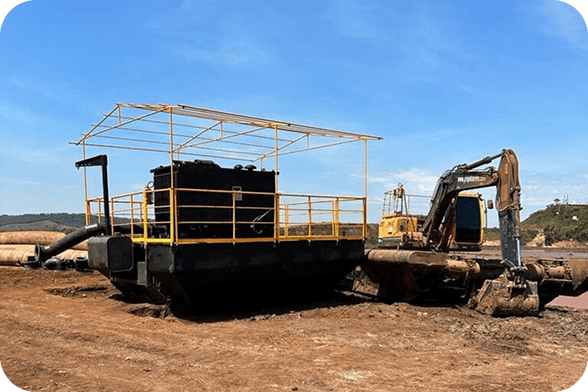
- Amphibious excavators;
- Long-reach booms;
- Custom buckets;
- Suction and discharge dredges
make it possible to carry out tasks more efficiently and with less downtime.
4. Applied engineering and customization as a competitive advantage
Applied engineering turns challenges into practical solutions. Instead of adapting the project to the available equipment, the equipment is adapted to the project’s reality.
In infrastructure project management, this approach:
- Reduces rework;
- Extends equipment service life;
- Optimizes resource use;
- Makes costs more predictable.
Customization is not an added cost. It is an investment in efficiency.
5. Integrating management, operations and logistics
Operational efficiency depends on teams working together. Communication gaps between engineering, operations and logistics create bottlenecks that drive up costs and delay the project.
Efficient infrastructure project management:
- Connects planning and execution;
- Aligns schedules and resources;
- Works with clear KPIs;
- Adjusts strategy continuously.
This systemic view is essential for complex projects.
6. Preventive maintenance and ongoing technical support
Unexpected downtime is costly in infrastructure projects. Preventive maintenance and specialized technical support are essential to keep work moving at a steady pace.
Best practices include:
- Preventive maintenance plans;
- Performance monitoring;
- Fast response to failures;
- Technical oversight throughout execution.
This reduces risk and increases the project’s overall efficiency.
Cost reduction comes from smart technical decisions
In infrastructure projects, reducing costs doesn’t mean cutting steps or compromising quality. It means making well-founded technical decisions, investing in applied engineering and choosing partners who can deliver tailored solutions.
Efficiency comes when planning, equipment, methods and management work together.
Tendasa is a strategic partner in infrastructure projects, offering complete solutions that combine applied engineering, the right equipment and specialized technical support. With a focus on efficiency, safety and sustainability, the company develops tailored solutions that reduce costs and improve operational performance.
If you’re looking for real efficiency, cost control and practical solutions for your infrastructure projects, talk to Tendasa and see how the right engineering transforms results.